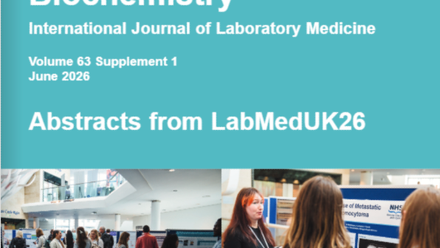
Ahead of LabMedUK26, members are invited to submit questions for a panel discussion featuring Chief Scientific Officers from across the four UK nations.
The Research and Innovation grant programme will move to a new autumn timetable, with applications opening in September to give members more time to prepare submissions after the summer break.
The Clinical Biochemist Reviews has relaunched as a fully open access journal, expanding global access to expert-led reviews and developments in clinical biochemistry and laboratory medicine.
A new report highlights the role of the infection-specialist workforce in strengthening infection prevention, improving patient outcomes, and preparing the UK health system for future healthcare challenges.
The IFCC Task Force on Outcome Studies in Laboratory Medicine is inviting research proposals focused on demonstrating the impact of laboratory medicine on patient care and healthcare outcomes.
The Advancing Healthcare Awards Northern Ireland and Cymru 2026 are now open for entries, celebrating excellence and innovation across healthcare science and laboratory medicine.
An international initiative led by IFCC and partner organisations is gathering insights from laboratory professionals to better understand the current landscape and future needs of clinical mass spectrometry.
Council has reviewed LabMed’s governance documents to ensure they are up-to-date, easier to understand and able to support the future needs of the organisation.
National Institute for Health and Care Excellence (NICE) is inviting experts to contribute to work exploring the use of AFP in the context of Hepatocellular Carcinoma.
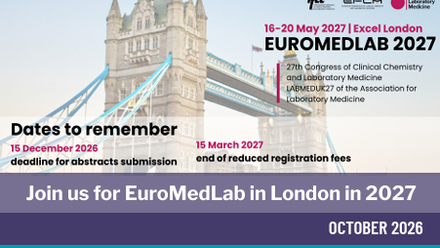
LabMed will be attending the ADLM Congress 2026 in Anaheim with a dedicated stand promoting EuroMedLab27 in London. Members attending the congress are encouraged to connect with Ian during the event.
EFLM position statement on the IVDR revision, highlights key implementation challenges and considerations with a focus on Article 5.5 and maintaining patient safety and access to reliable diagnostics.
The guidance focuses on ensuring IVDs are fit for purpose within ISO 15189 requirements. It reinforces laboratories’ responsibility to verify and, where necessary, validate device performance in their own clinical context, including assessing accuracy, precision, sensitivity and specificity.
Validation Guidance for medical laboratories, created in collaboration with IBMS, MHRA and UKAS, focuses on ensuring IVDs are fit for purpose within ISO 15189 requirements.